OMEGA 693-20

OMEGA 693-20

OMEGA 693-20


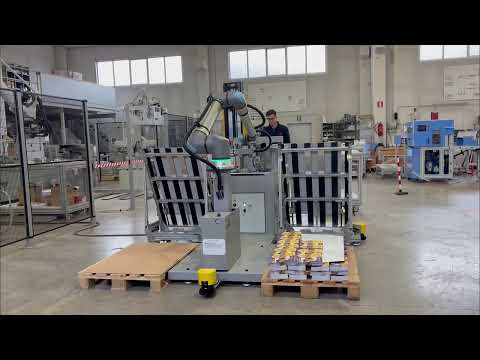
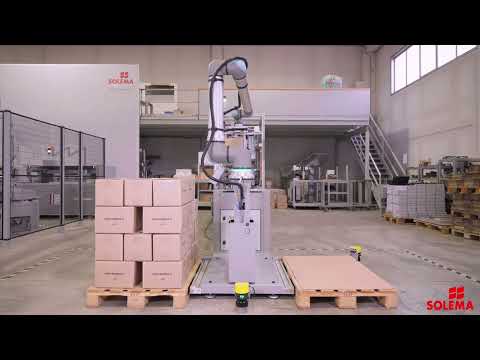
Omega 693-20 is an automated palletizing solution based on collaborative robotic technology with an anthropomorphic arm, designed to handle a wide range of products as sewn, digital and gauzed books as well as soft cover and hard cover books and boxes.

The system is equipped with a specially designed gripping tool, engineered to move stacks of products and place them into the pallet in a single operating cycle, ensuring high efficiency in production workflows.

Thanks to its collaborative architecture and compliance with safety standards, Omega6 93-20 does not require protective grids, making it ideal for dynamic production environments and for quick relocation between different lines or workstations.

The software allows for full customization of the palletizing pattern, including the ability to change the orientation of each stack to meet specific packaging or logistical requirements.

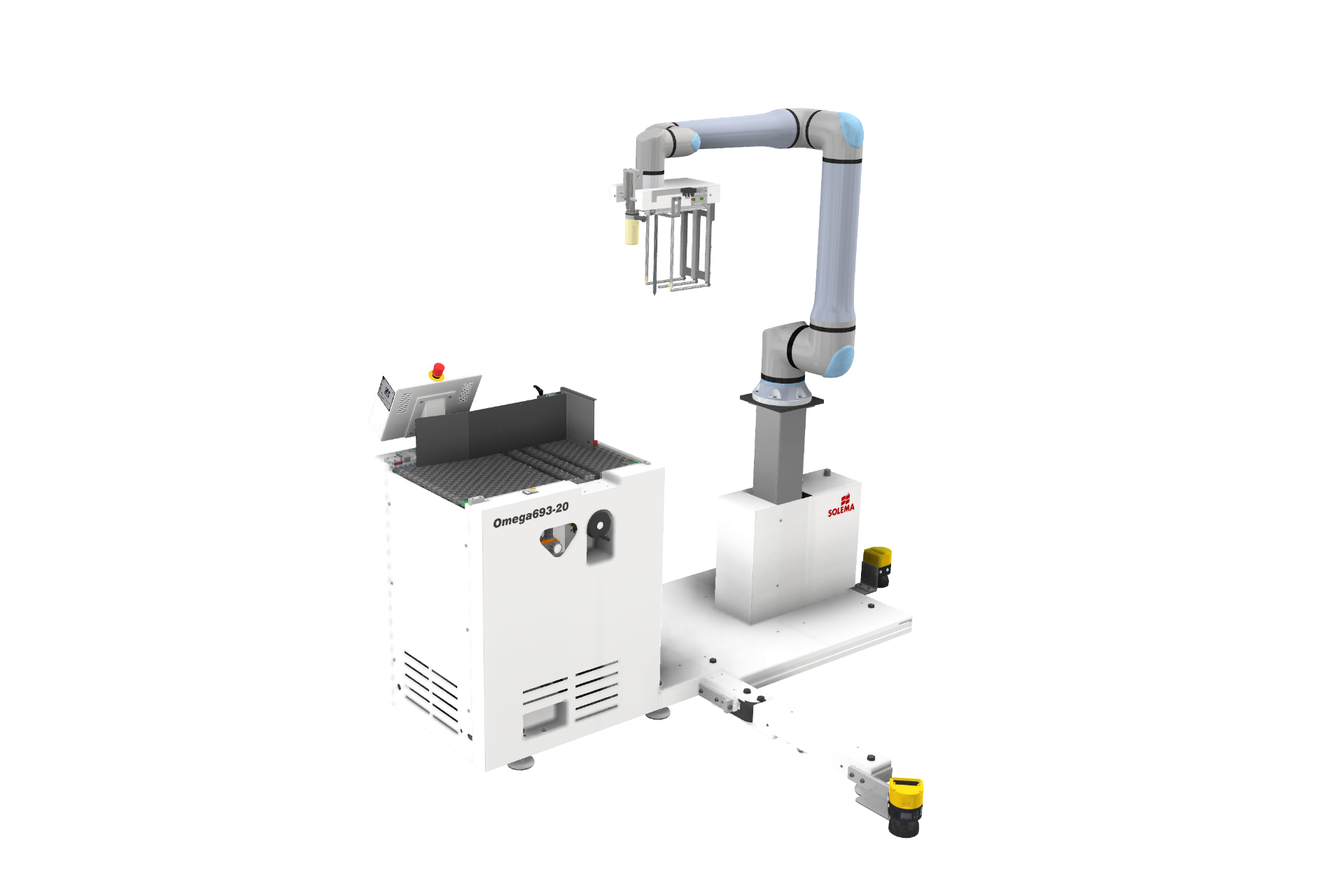
The solution consists of two integrated units:

  • Collaborative robot

  • Dedicated pick-up station

Both will be managed by the dedicated HMI, allowing production control and recipe creation from a single interface.


Request Information

Technical Data

Machine speed

max. 5 cycles/minute

Product dimensions (L x W x H)

min. 150 x 150 x 60 mm (5 7⁄8 x 5 7⁄8 x 2 3⁄8”)

max. 400 x 250 x120 mm (15 3⁄4 x 9 7⁄8 x 4 3⁄4”)

or

min. 150 x 200 x 60 mm (5 7⁄8 x 7 7⁄8 x 2 3⁄8”)

 max. 400 x 330 x 235 mm (15 3⁄4 x 13 x 9 1⁄4”)

Product weightmax. 14 kg (31 lb)
Pallet dimensions1200 x 800 mm (48 x 31 1⁄2”) 

Video Gallery

FAQ

A palletizing cobot is a collaborative robot that automatically builds pallets at the end of the line and, unlike traditional industrial robots, can operate alongside operators without safety fencing. Solema's Omega 693-12 is engineered specifically for the graphic arts industry. The cobot is mounted alongside the infeed roller conveyor on a single wheeled base, palletizing book stacks within a compact footprint.
The Omega 693-20 is a palletizing cobot—a collaborative robot that automatically builds pallets at the end of the line, working safely alongside operators without protective fencing. It is the 20 kg payload version of Solema's Omega 693 family. The cobot and infeed roller conveyor are mounted on a single wheeled base, designed to palletize book stacks including large-format and heavy products.
The stacks arrive on the integrated roller conveyor and the cobot picks them with a mechanical gripper, while a pressure cylinder holds them firm during movement. Before each placement, dedicated sensors check the pallet height and product presence. The cobot can operate on one or two pallets and, with the automatic layer sheet option, autonomously places interleaves upon completion of the layers specified in the recipe.
Yes, as an option. The Omega 693-20 can be equipped with two magazines ,one for each pallet mounted to the base. The cobot picks cardboard layer sheets (interleaves) and places them between layers according to the frequency set in the recipe, without operator intervention.
Safety laser scanners constantly monitor the area around the cobot. If an operator approaches, the cobot reduces its operating speed; if the distance drops below the safety threshold, it stops and automatically resumes once the area is clear again. Thanks to this system, full pallets can be replaced without interrupting production.
Yes. When product dimensions and layout allow, the cobot picks two stacks in a single motion. Solema's proprietary software also manages complex palletizing, , including product rotations and interlocking layers to ensure pallet stability.
Yes. The wheeled base allows the Omega 693-20 to be easily transferred from one line to another. The side support arms which serve as pallet stops and position the laser scanners correctly fold away to make relocation even simpler.
Yes. The cobot is available in various configurations detailed in the machine's technical catalog. For sizes not listed in the standard catalog, customized engineering solutions can be evaluated during the design phase.