A €4 million automation project helping Mayr Miesbach boost productivity, speed and efficiency across its industrial perfect-binding line with two Solema solutions.
A major industrial perfect binding automation project, a 4 million euro
investment, and a clear goal: to increase productivity, speed, and efficiency
across the entire line. This is the context behind the recent case study
featuring Mayr Miesbach, a prominent German player in the printing industry,
who relied on two Solema machines to enhance its performance.
The Mayr Miesbach case study: Solema’s value for an industrial perfect binding line
In the Graphic Arts industry, when discussing industrial perfect
binding, line efficiency does not depend solely on the binder's speed, but on
the ability to integrate the various process stages into a continuous,
automated workflow. It is within this framework that the project commissioned
by Mayr Miesbach, a major German printer, came to fruition, with contributions
from Solema and Müller Martini.
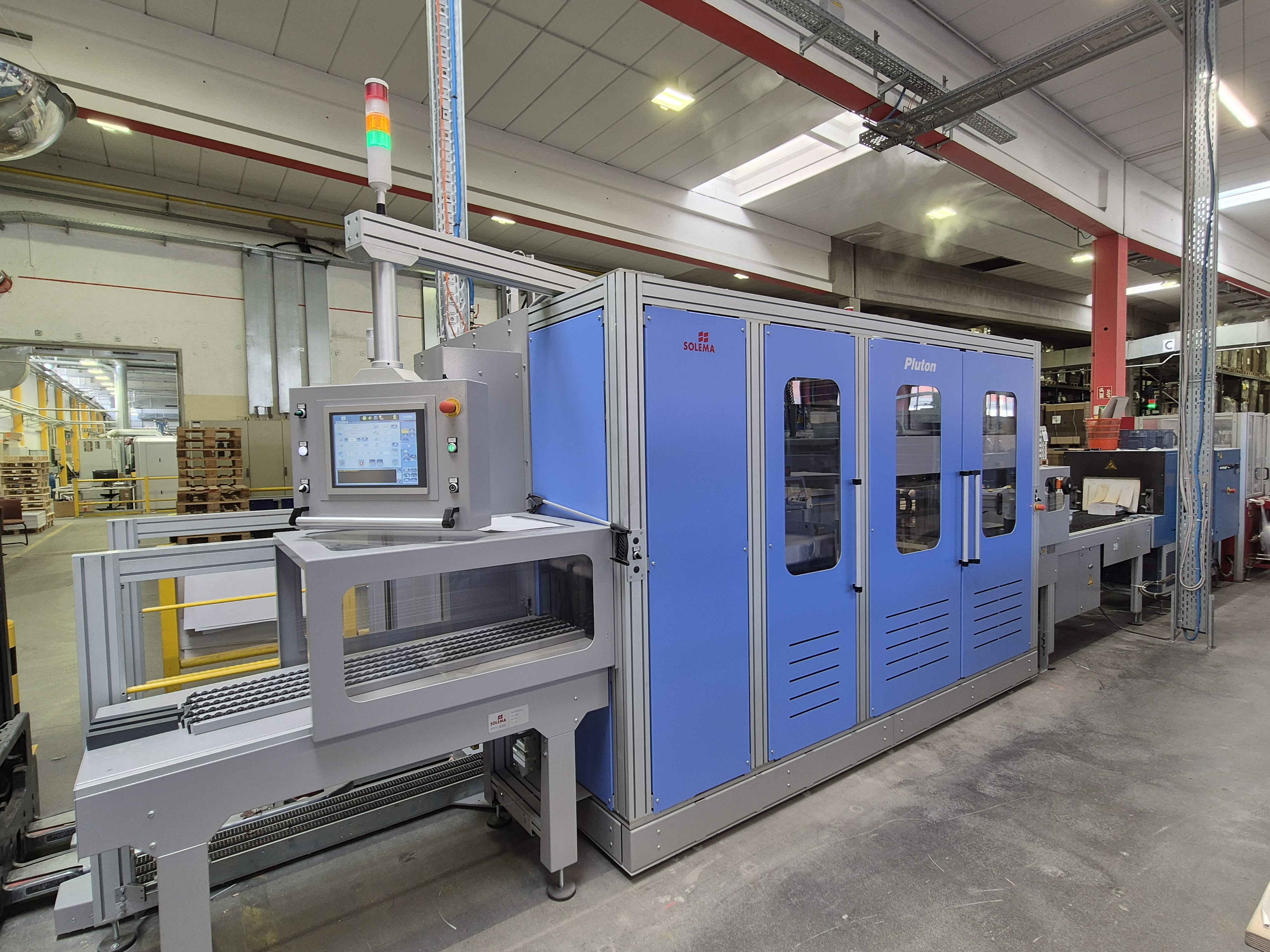
A concrete example of how end-of-line automation can decisively impact plant performance. In a new high-performance industrial perfect binding line by Müller Martini, Mayr Miesbach chose to integrate two highlights from Solema: the Pluton automatic palletizer, combined with the performance of the Fastbook& Autoload automatic feeder.
Mayr Miesbach: a long-standing partner and benchmark in the German
market
With over 150 years in business, Mayr Miesbach is a benchmark in
printing for German-speaking countries. Based near Munich, the company
specializes in producing coated paper magazines, perfect-bound catalogs,
brochures, and customized special inserts, managing the entire production cycle
in-house: from prepress to printing, finishing, and shipping.
What makes Mayr Miesbach an interesting case study is its ability to
cover run lengths ranging from 5,000 to one million copies while maintaining
high quality standards and strong production flexibility. Mayr Miesbach and
Solema share a historic partnership spanning over twenty years: a relationship
built on reliability, continuity, and mutual understanding of production needs.
The customer’s need: boosting competitiveness and performance in perfect
binding
Mayr Miesbach handles approximately 3,000 orders per year, processes
15,000 tons of paper, and produces up to 50,000 catalogs in different
languages, countries, and versions. These figures reflect a high-profile
organization with 135 employees working across 3 shifts in a repeatedly
expanded 10,000-square-meter facility.
It was not a matter of resolving a critical issue, but rather the desire
to make another leap forward in quality. The goal was to maintain the standards
that have made Mayr Miesbach a leader in the German market while equipping the
plant with an even higher-performing solution to address growing job
complexity, high order volumes, and the need to optimize time, resources, and
labor.
A 4 million euro investment for a fully automated line
This need gave rise to a 4 million euro project developed by Mayr
Miesbach alongside two strategic partners:Solema and Müller Martini, a global
leader in manufacturing innovative print finishing systems for brochures,
magazines, and books.
The core of the investment is a new high-performance industrial perfect
binding line designed to handle high production volumes, frequent format
changes, and a highly automated workflow. The goal was to ensure continuity
throughout the line, from feeding book blocks to automatically palletizing the
finished product, minimizing manual tasks and increasing control over the entire
process.
Publica PRO: the top-of-the-range line incorporating Solema’s expertise
The Publica PRO operates at up to 15,000 cycles/hour thanks to the KM
413.C perfect binder, which uses PUR/hot melt glues to ensure high quality,
long-term durability, and reduced set-up times. Line operation is managed via a
touchscreen control system that speeds up procedures and simplifies tasks.
However, in a plant of this caliber, performance depends not only on the
binder itself, but also on the efficiency of the upstream and downstream
stages. And this is where Solema comes into play.
Solema’s role in the project: upstream and end-of-line automation
Within this project, Solema oversees two strategic phases of the
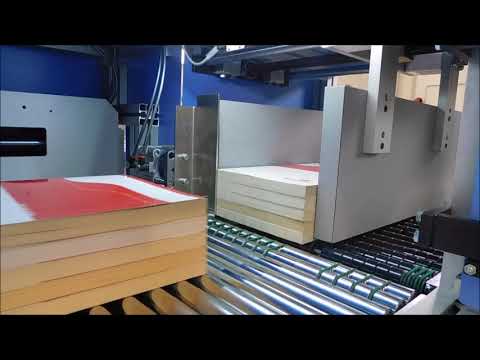
process: upstream, the Fastbook & Autoload automates book block feeding
into the gathering line. Downstream, the Pluton takes charge of the finished
product after binding, drying, trimming, and packaging, managing the end of the
line with continuity, precision, and flexibility.
In summary, the workflow is structured as follows:
• Book block feeding
via Solema Fastbook & Autoload;
• Binding via the Publica PRO binder;
• Film wrapping of bundles;
• Final
palletizing via Solema Pluton.
Pluton: the automatic palletizer as a “key tool” in the project
Solema Pluton is the iconic automatic palletizer launched in 2003.
With over 400 installations worldwide, it has become the gold standard for
automatic palletizing in the graphic arts sector thanks to its blend of
compactness, efficiency, and operational versatility.
Pluton is Solema’s standout solution in this project, not only for its
high, proven performance, but because it fulfills the key task of picking up
finished products downstream and managing automatic palletization.
Pluton is designed to handle various product types, including:
•
Hardcover or softcover books;
• Sewn or unsewn (glued) book blocks;
• Magazines, catalogs, and directories;
• Film-wrapped, strapped, or boxed stacks/bundles;
• Cardboard boxes and other finished graphic arts products.
A key strength of the Pluton is its extremely small footprint: just 15
m², making it the most compact automatic palletizer in its performance class.
In Mayr Miesbach case, Pluton was configured to handle both loose
product stacks and film-wrapped, tied, or packaged stacks, with the capability
to use different pallet sizes and manage up to 7 pallets in the magazine.
Pal-Feeder: added value in automatic pallet feeding
A key feature of Mayr Miesbach setup is the Pal-Feeder, an automatic
pallet loader that automates feeding pallet stacks into Pluton’s magazine.
Automatic magazine feeding is accomplished via elevators, making an
operation that would otherwise require direct operator intervention simpler,
neater, and far less labor-intensive. In this way, Pal-Feeder reinforces the
end-of-line automation concept, improving ergonomics, workflow continuity, and
overall system management.
Fastbook & Autoload: the automatic book block feeder at the start of
the line
Alongside Pluton, the project also utilizes another Solema machine:
Fastbook & Autoload, an automatic feeder designed to destack book blocks
and feed them smoothly and consistently into the Publica PRO’s gathering line.
Its presence upstream is essential because it automates a delicate phase
of the process, ensuring continuity across the entire operation. In this sense,
Fastbook & Autoload and Pluton represent two ends of the same Solema
engineering philosophy: automating both line entry and exit to help build a
more efficient, stable production flow.
Integration with Connex: another strategic advantage from Solema
Making the project even more unique is Pluton’s seamless integration
with Connex, Müller Martini proprietary software governing the entire line’s
workflow.
Pluton, like all machines built by Solema, is fully capable of
communicating seamlessly with Connex, natively integrating into the Publica
PRO’s operational logic. As a result, Solema’s top-tier palletizer is not just
an end-of-line component, but an active part of a fully interconnected
production system that communicates with the rest of the facility and boosts
overall line efficiency.
This makes Pluton an even more strategic solution wherever a strong
“Connex ready” integration is required, featuring quick format changes,
advanced automation, and centralized flow management.
Project results: higher productivity and reduced labor
The numerous results achieved by Mayr Miesbach confirm the value of the investment. Thanks to the new configuration, the German company has benefited from:
• High production speed;
• Consistent, top-tier quality;
• Reduced labor requirements;
• Easier operation across the entire plant;
• Optimized end-of-line operations;
• Flexible management of pallets and formats.
The advantages are also tangible in terms of labor organization: managing the entire line across 2 shifts requires only 3 operators. Added to this are the end-of-line benefits, where Pluton allows pre-selecting the number of packages per pallet and the pallet height, as well as flexibly managing different pallet sizes.
A project confirming the value of end-of-line automation
For Solema, this case study represents much more than a simple installation: it is proof of the value an end-of-line automation solution brings to a high-performance industrial perfect binding plant. In a project developed for a top player in the German market, the combined choice of Pluton and Fastbook & Autoload demonstrates once again the reliability of Solema’s technologies and their ability to integrate into complex, advanced, and highly automated production workflows.
If you are evaluating an end-of-line automation project for the Graphic Arts, bookbinding, or packaging sectors, write to info@solema.it or call +39 035 654111. The Solema team is at your disposal to build the solution best suited to your plant's needs.