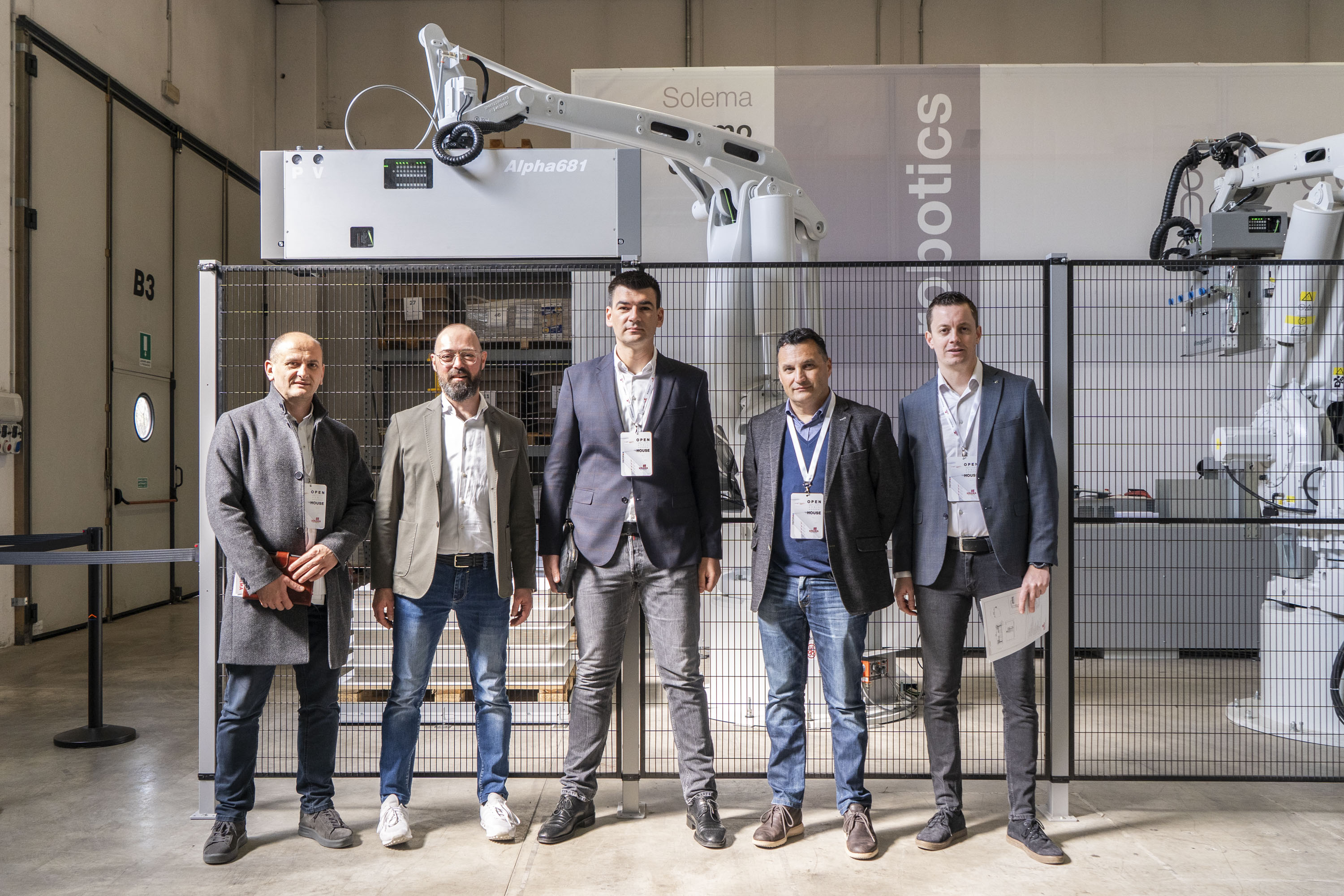
Since 2011, we have shared a journey of growth with a major company in Bosnia and Herzegovina operating in the Graphic industry. What began as a simple supply relationship has gradually evolved into a solid partnership, built on mutual trust, attentive listening and shared goals.
Today, we’re sharing a special case study that highlights the long-term collaboration between Solema and Grafotisak, a leading name in the
Graphicart sector in Bosnia and Herzegovina.
A partnership that extends well beyond the supply of a single machine, showing how combining experience and technical know-how can generate real, lasting value.
What began as a response to specific needs has grown into a shared project, shaped by targeted, tailored solutions built around the client’s requirements.
Nearly fifteen years of collaboration have cemented our relationship with one of our longest-standing partners.
Grafotisak: a major player in Graphic industry
Grafotisak is headquartered in Grude – where its main headquarters, production site for graphic products and central warehouse for the Distribution of office, school and graphic materials are located – and three branches with distribution centres for the office, school and graphic materials throughout the country - in Sarajevo, Banja Luka and Tuzla.
Founded in 1983, the company has grown into an internationally recognised business group, specialising in the production of graphic products and the distribution of office and school supplies, with a catalogue of around 15,000 items.
Grafotisak is a regional leader in the printing industry and the only industrial producer of the lever arch files in South – Eastern Europe, known for its professionalism and recognised internationally as a trusted partner in over 15 European countries. Exports account for 80% of total production. Grafotisak is a group with leading market position in Distribution of office, school and graphic materials in Bosnia and Herzegovina and Republic of Croatia, and growing market position in Republic of Serbia. Its success is built on the consistent adoption of the latest technologies, software and materials, combined with strong human resources – more than 600 employees across its various locations.
Our first contact with Grafotisak dates back to 2011, with relations intensifying between 2016 and 2017, during which time the market began shifting rapidly towards automation in the Graphic industry, an area where Solema stands out as a leader. Starting from 2019, the relationship grew even stronger, giving rise to a stable, ongoing collaboration built on mutual trust and a continuous dialogue focused on innovation.
From the first machine to a fully automated project: timeline of a successful partnership
Our first meeting in 2011 and 2015 led to Grafotisak purchasing of two hardcover binding lines.
The success of this initial delivery paved the way for a second meeting, for the purchase of an IdealGandria, — a historic Solema machine for producing paperboard pads — which proved to be a turning point in the relationship: from there came the supply of four Pluton systems for automatic end-of-line palletising and two semi-automatic Smart Box boxing machines, with the aim of automating the packing process.
By 2020, the project had taken full shape with the delivery of an integrated Packaging Line, equipped with a Venus automatic depalletizing system for the initial handling of the finishing flow, integrating processes such as shrinkwrapping, dust jacketing and cartoning, right through to the final automatic palletising stage handled by Pluton.
This specific Packaging Line model was designed to meet the client's specific needs at the time, when they were operating with two hardcover and two perfect binding lines, while optimising the use of a large workforce dedicated to finishing operations.
In May 2022, Grafotisak began reorganising its production processes, aiming to speed up the existing lines and increase the end-of-line efficiency. However, logistical efficiency remained limited by the layout of the facilities: the printing press and packaging line, though interconnected, were in separate areas of the plant.
To overcome this and support further growth, a reorganisation of the production floor was initiated in 2022, culminating at the end of 2023 with the full relocation of the lines, significantly reducing internal handling costs.
Following this reorganisation, a new requirement emerged: automating the line loading process, which was still being carried out manually.
To meet this need, in 2024 the client decided to invest in three Alpha681 robotic arms for automatic depalletizing, thus completing a fully integrated automation cycle.
A step-by-step summary of the entire project
Step 1 – End-of-line automation (pre 2019)
Objective: to reduce manual labour and increase end-of-line efficiency.
- Introduction of the first Pluton automatic palletising systems.
- Implementation of two Smart Box solutions for box production, to reduce manual labour.
Step 2 – Installation of the Integrated Packaging Line (2020–2021)
Objective: to centralise and automate packaging to handle multiple product types.
- Analysis of the existing four lines (two hardcover, two perfect binding).
- Design of a centralised Packaging Line equipped with Venus at the beginning and Pluton at the end.
- Reduction from 5 to 2 operators per line.
Step 3 – Reorganisation of logistics and production layout (2022–2023)
Objective: to optimise the production flow and prepare the facility for future growth.
- Redesign of layout to resolve logistical inefficiencies between printing and end-of-line packaging.
- Internal relocation of all lines to improve continuity and operational proximity.
Step 4 – Completion of line automation (2023 to present)
Objective: to eliminate the remaining manual operations and standardise automation levels.
- Purchase of three Alpha681 robotic systems to automate loading ahead of Fastbook.
- Optimised use of personnel and maximised production speed without interruptions, completing the automation cycle.
4 improvement steps towards a fully automated and flexible industrial system.
Why was automation the only viable path?
Without a tailored technical solution and consistent support throughout the evolution of its production process, Grafotisak would have remained dependent on manual labour, leading to inevitable increases in operating costs and reduced ability to adapt to changing demand.
In particular, the absence of automation would have limited the scalability of the perfect binding and hardcover lines, exacerbating bottlenecks in the finishing processes and slowing down the entire production cycle.
In a fast-paced, highly competitive market, automation is now the key to ensuring efficiency, flexibility and operational continuity.
From dispersion to control: the value of reorganisation
One of the initial challenges was the dispersion of semi-finished products: without a clearly defined production flow, it becomes difficult to maintain control over the product as it moves through the various stages of the process.
To address this issue, the production layout has been completely reorganised, including the repositioning of machines within the facilities. This restructuring made it possible to optimise internal flow, track product movement, and improve overall processing times.
An additional benefit was the improvement in operator well-being, thanks to shorter walking distances within the production facility and more efficient working times.
Trust developed over time: why the customer chose to rely on us
Achieving the client’s initial goal required cross-disciplinary expertise and a wide range of technologies.
The trust developed over time, our in-depth understanding of production processes and our high standing in the Graphic industry made us the ideal partner.
The breadth of our machine portfolio meant the client was able to work with a single point of contact, gaining access to integrated, easy-to-manage solutions.
Our work therefore delivered value on two levels: on one hand, it supported the client in transitioning to a leaner, faster and more sustainable production model; on the other, it strengthened a relationship of trust that enabled us to work in perfect harmony, achieving the best possible outcome.
What were the tangible results for Grafotisak?
One of the most significant outcomes of the project was the reallocation of resources across the production lines. Automation made it possible to reassign 40 operators – previously engaged in repetitive and physically demanding tasks – to more skilled roles with higher added value.
This shift improved both staff motivation and the overall efficiency of the organisation. Initial performance indicators, currently under analysis, confirm the success of the intervention.
A clear example of how automation can generate value, even on a human level.
… and what about the intangible benefits?
The whole reorganisation process and collaboration brought not only physical improvements where benefits were immediate: smoother workflows, faster turnaround times, and improved consistency in quality, ultimately leading to greater customer satisfaction and a better overall experience. But just as importantly, the project delivered deeper intangible benefits. It has enhanced workplace well - being, supported the upskilling of customer’s employees, and reaffirmed their commitment to a culture of innovation. Grafotisak has also strengthened its position in the graphic industry by staying ahead of technological trends and pushing the boundaries of what they can offer.
Has the project opened up new opportunities?
This transformation has opened up a world of new opportunities, such as operational growth (with reduced production times and increased production capacity), improved workplace health and safety (with reduced manual work and enhanced support for the personal development), market opportunities (with higher-quality output and greater flexibility) and sustainability (with major reductions in environmental framework due to lean introduction). This is more than a facility upgrade. It is a statement of intent: Grafotisak is future - ready, innovation - driven, and focused on creating lasting value for their people, customers, and for the industry.
Are you a business owner in the Graphic industry and interested in building a constructive partnership with us? Write to info@solema.it or call 035 654111.